Knowing the Waters
By Tim Schermetzler of CSD Attorneys at Law P.S.
Budget Season
It’s fall, which means it is soup season. Fall is also budget season for most ports, and just like tasty soup, a lot of ingredients go into a port’s budget. This month’s column explores some budget basics – the ingredients of a good budget recipe.
A port’s adopted annual budget shows the estimated expenditure and anticipated available funds and revenue for the ensuing fiscal year1. The budget is a keystone document, legally required and necessary for port staff to spend money and incur other financial obligations. Chapter 53.35 RCW provides the basic legal requirements for port budgeting. Except where a port has elected an alternative budget schedule under RCW 53.35.045, the budget schedule is as follows:
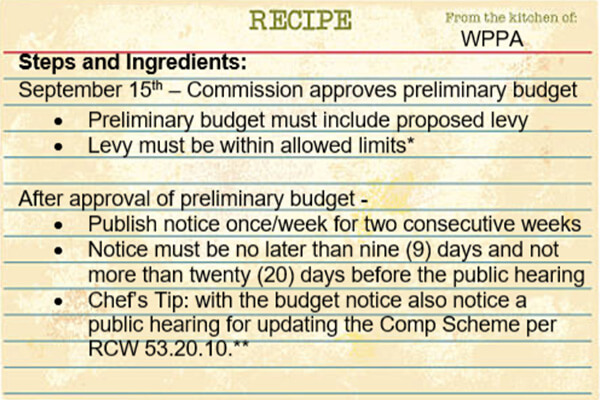
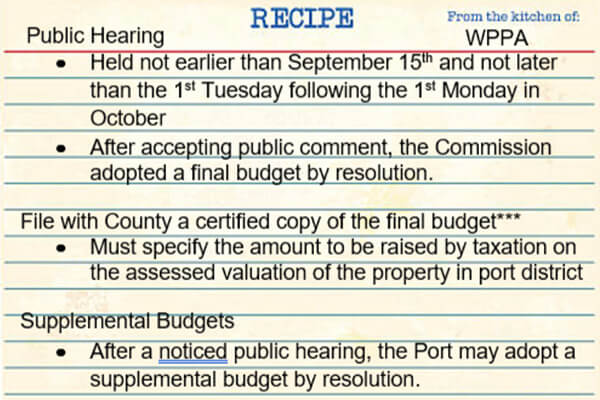
Notes from the Budget Recipe:
* The property tax levy (total tax revenue collected) is generally limited to an increase of one percent (1%), plus new construction, in any year2. Ports may also have “banked capacity,” which is unused tax capacity from prior years that may be imposed provided the port follows the required statutory processes3.
** Update comp scheme at same time as budget approval. A best practice is to formally amend the Comp Scheme to reference the capital budget each year. The notice and public hearing provisions for port budget adoption in RCW 53.35.020 and RCW 53.35.030 are nearly identical with to the notice and public hearing provisions for amending the Comp Scheme in RCW 53.20.010. In fact, a single required public notice could be crafted to satisfy both the budget adoption and the Comp Scheme amendment.
*** RCW 53.35.040 requires the certified copy of the budget to be filed on or before the Wednesday next following the first Monday in October. RCW 53.35.045 permits a port to file with the clerk of the county legislative authority a certified copy of the budget by the first Monday in December. Note that the tax levy must be certified no later than November 30th. A port may also set other dates relating to the budget process, including but not limited to the dates set in RCW 53.35.010 and .020 to conform to an alternative date for final budget filing.
Beyond the basic legal recipe, crafting a budget offers the port an opportunity for strategic thinking and planning. Most ports start planning for the budget months in advance of the first legally required deadlines in September. These ports, among other things, prepare financial reports and budget analysis, hold commission and staff retreats to discuss strategic goals and set priorities, and update strategic documents ahead of the fall budget season. To use our soup season analogy, think of this prep work as planting and tending to the vegetables in your garden all spring and summer long so those vegetables are ready for soup season.
While Chapter 53.35 RCW only requires an annual budget, some ports adopt draft budgets and capital facility plans4 for the succeeding three to six years. This practice allows ports to look ahead to see how the annual budget harmonizes with future budgets and long-term capital planning. In addition, as discussed above, many ports update another strategic keystone document – the CSHI or Comp Scheme – annually at the same time as approving a final budget. Many of the ingredients of your budget recipe may come from, or be informed by, the Comp Scheme. By routinely amending the Comp Scheme to include the projects in the capital budget, a port (i) ensures that the commission reviews the Comp Scheme annually, (ii) ensures the Comp Scheme is consistent with all budgeted capital projects, and (iii) minimizes risks of a legal challenge to a capital project based upon inconsistency with the port’s Comp Scheme.
Additionally, the budget pairs with other keystone documents: a Budget is to soup as the delegation of authority is to a good piece of bread – a necessary pair. The concept of budget-based management relies on the budget working in concert with the delegation of authority so the port’s managing official can take actions necessary for port operations within the confines of what the commission ultimately approved. The effective pairing of these keystone documents empowers the port’s managing official to conduct the operations of the port in a timely and efficient matter, and allows the commission to spend its valuable time on the big-picture strategic decision and governance decisions of the port.
Hopefully your port is cooking up a good budget soup this fall. As always, if you have specific legal questions, work with your port’s legal counsel. If you have a general question or topic of interest for Knowing the Waters, please e-mail me at [email protected].
1 The Washington State Auditor’s Office BARS Manual Section 2.4.3 (cash manual and GAAP manual) provides a quick overview of the budget adoption requirements for ports along with other special purpose districts.
2 RCW 84.55.010.
3 RCW 84.55.092 and .120.
4 A capital facility plan (“CFP”) is a multi-year planning and financing document used to manage public infrastructure and physical assets. Unlike cities and counties, ports are not required to create a CFP as part of the Growth Management Act – Chapter 36.70A RCW (“GMA”); rather, a port’s statutorily required financial and planning document is the Comprehensive Scheme of Harbor Improvements (“CSHI”) required by RCW 53.21.010.